You have already made it through the renovation decisions, the material samples, the contractor schedules, and the final walkthrough. The wide-plank floors are finished. The custom millwork is painted. The stone in the foyer is exactly where it should be.
Now several thousand pounds of furniture, appliances, artwork, and boxed belongings have to pass through the house in a single day.
That is where the real risk begins. Most moving-day anxiety centers on what goes inside the truck. Will the antique dining table be scratched? Will the custom sectional arrive without a tear?
Those are valid concerns, but in a high-value home, the building itself may be just as difficult and expensive to repair as anything being moved.
White glove movers New Jersey homeowners trust should protect more than furniture. They should treat the floors, walls, doorways, staircases, and architectural details at both addresses as part of the move.
A newly completed custom home in Alpine may include imported stone, wide-plank hardwood, oversized doors, built-in cabinetry, and freshly finished walls.
A historic estate in Short Hills may have original plaster, narrow openings, hand-finished trim, and a staircase that was never designed for a modern king-size bed or modular sofa.
These homes present different challenges, but the principle is the same. A finish can be valuable because it is new, rare, custom made, or nearly impossible to reproduce.
The damage does not have to be dramatic to be expensive.One sharp wheel can leave a track across soft wood. A metal bed frame can chip a door casing. A dresser turned too late on a stair landing can strike a newel post. Grit carried in from the driveway can act like sandpaper under a moving runner.
A standard move often treats the house as a passage between the furniture and the truck. A white-glove move treats the house as an asset that requires its own protection plan.
Historic does not automatically mean fragile, and new does not automatically mean durable.
The risk comes from the combination of materials, geometry, weight, and traffic.In an older North Jersey estate, plaster may react differently to impact than modern drywall. Original woodwork may have profiles that cannot be matched with an off-the-shelf replacement. Doorways may be narrower, stair turns tighter, and floors less level than they appear in listing photographs.
In a custom build, the challenge is often the finish quality. Newly coated floors, polished stone, frameless glass, integrated lighting, oversized pivot doors, and precisely aligned millwork leave little margin for careless handling.
Experienced estate movers in North Jersey look for the places where those conditions meet.
Foyers and Entryways
Every carton, tool, dolly, and furniture piece crosses the main entry.That makes the foyer the highest-traffic zone of the move. Thresholds, sidelights, front-door hardware, and the first section of interior flooring need protection before repeated trips begin.
Staircases and Landings
Staircases combine weight, limited visibility, elevation, and tight turning space.The highest-risk points are often the newel post at the bottom, the outside railing on a turn, and the wall at a landing where a large item must be repositioned.
Door Jambs and Custom Millwork
A sofa can clear the open doorway and still scrape the casing.A wardrobe may fit through the hall but leave no room for the crew’s hands. In historic homes, even a small chip can become a restoration problem rather than a simple paint touch-up.
Finished Floors
Protecting hardwood floors during moving requires more than keeping shoes clean.
Dollies create rolling loads. Furniture legs and dropped hardware create concentrated point loads. Natural stone and tile add their own concerns, especially at transitions and thresholds.
The most effective protection is not a blanket. It is a decision made early enough to prevent an unsafe route from being attempted.
Before moving day, a professional coordinator should assess both the origin and destination. Photographs and a video walkthrough can help with early planning, but complex homes often benefit from an in-person review.
The objective is to identify the difficult pieces, the vulnerable surfaces, and the safest path through each property.
.png)
Door width alone does not tell the full story.
The crew needs to consider handle clearance, trim depth, ceiling height, railing position, turning radius, and the space required for hands and protective padding.
Large furniture should be measured at its rigid points, not only at its soft cushions.
A sectional base, dining-table pedestal, armoire crown, or appliance handle can determine whether a piece can make the turn.
The shortest path is not always the safest.A slightly longer route through a wider side entrance may avoid a narrow foyer, a fragile threshold, or a staircase with original millwork.
At the destination, the route should be planned before the truck is opened so protection is ready before unloading begins.
Forcing a piece through a space is not a sign of strength or experience. It is a planning failure.If a modular sofa, bed frame, table, or cabinet can be safely disassembled, doing so may reduce both the weight and the turning radius.
Hardware should be labeled and controlled, and reassembly should be included in the placement plan. A qualified historic home moving company should also know when not to disassemble an old or delicate piece without a specialist.
Luxury moves are rarely as clean as emptying one house and filling another on the same afternoon. Renovations run long. Designers want rooms staged in a certain order. Sometimes the new home isn't fully ready by the time the old one has to be empty.
This is exactly where staggered move-ins and climate-controlled storage earn their keep, and where Groove Moving's storage coordination comes in.
A full-service estate mover can hold some or all of your belongings in secure, climate-controlled storage, then deliver in phases that line up with your designer's schedule and your renovation timeline.
Your art isn't baking in a hot garage waiting on a contractor. Your bedroom can be set up and livable while the rest of the house is still being finished. Pulling movers, designers, and trades together under one timeline is really what separates a stressful move from a smooth one.
No single material protects every surface.
The right system depends on the floor finish, the weight being moved, the weather, the route, and the sensitivity of the architecture. A luxury moving company in NJ should be able to explain what it plans to use and why.
1. Rigid Floor Protection for High-Traffic Paths
Thin adhesive film can help keep carpet clean, and neoprene runners can create a defined walking lane. Neither provides the same impact resistance as a rigid overlay.
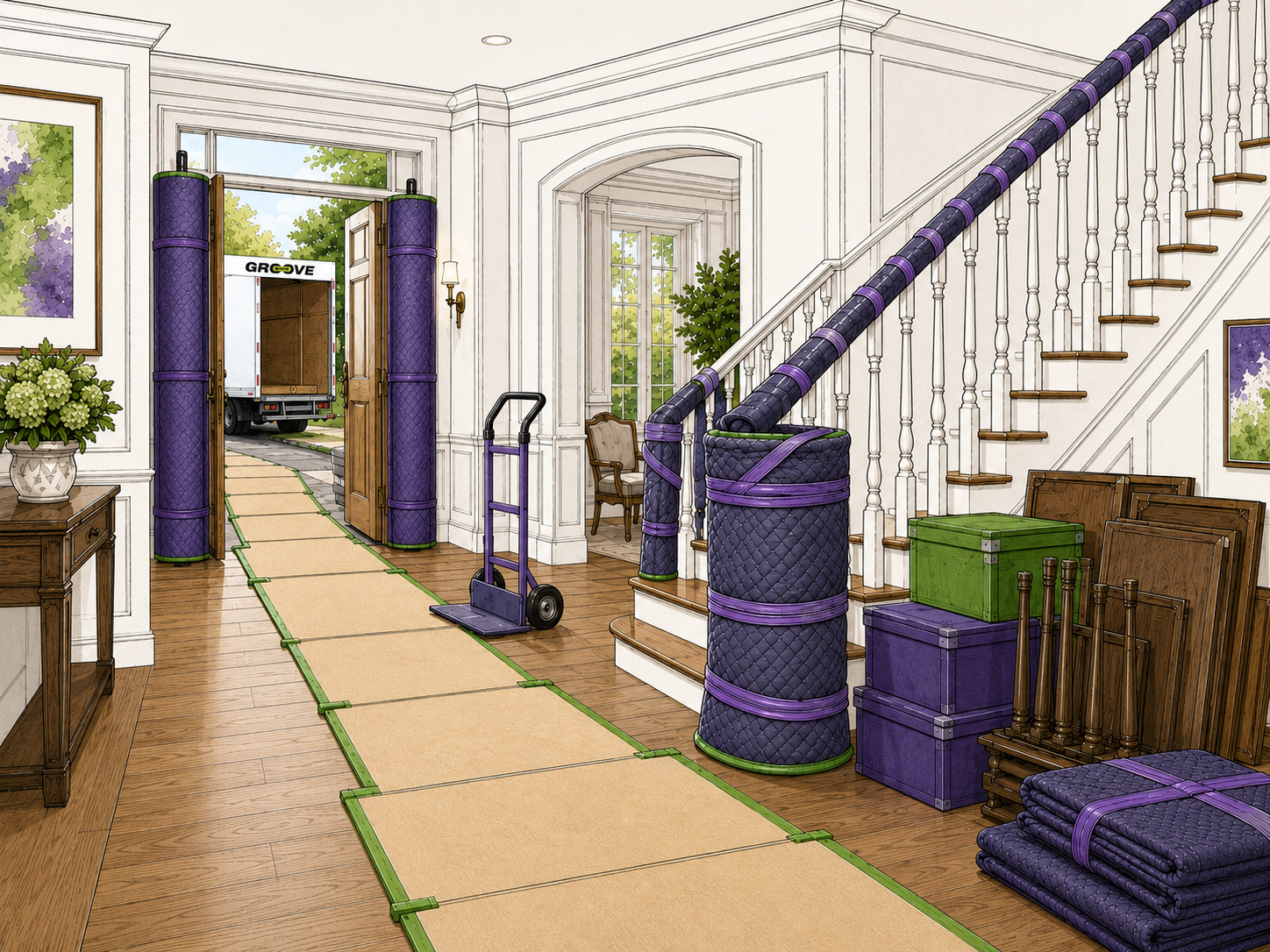
For routes crossing pristine hardwood, stone, or custom tile, crews may use interlocking hardboard sheets, commonly referred to as Masonite protection.
The rigid layer helps distribute rolling loads from dollies and provides a buffer against dropped tools, metal edges, and concentrated pressure.Installation matters.
The panels should lie flat, remain stable under traffic, and be suitable for the surface beneath them. Edges and transitions must not create a new trip hazard.
Delicate or recently finished floors may require a compatible underlayer and a protection method that avoids direct adhesive contact.
The question is not simply, “Do you cover the floor?”
Ask what material will be used on each surface and whether it is intended to protect against dirt, impact, rolling weight, or all three.
2. Padded Door Jamb Protectors
Door casings are vulnerable because the available opening becomes narrower once hands, padding, and the furniture itself enter the same space.
Spring-loaded or clamp-style jamb protectors wrap the exposed frame in thick padding without requiring tape on the painted or finished surface.
They create a visible, forgiving boundary around a tight opening and absorb incidental contact that might otherwise chip paint or dent custom trim.
The protector does not make an impossible clearance possible.It works best when the piece has already been measured and the crew knows the intended angle of approach.
3. Tension-Wrapped Staircase Protection
Fine railings, balusters, handrails, and newel posts should not become temporary supports for heavy furniture.
When the route uses a staircase, vulnerable components can be enclosed in heavy moving blankets and secured with non-adhesive stretch wrap or another surface-safe tension system.
The goal is full, stable coverage without sticky residue on wood, metal, or painted finishes.
Corners and prominent posts often need additional padding because they receive the first contact when a piece rotates at a landing.Crews also need a communication plan.
One person should direct the turn, confirm hand positions, and stop the movement before the item enters a blind angle.
Padding helps, but coordinated movement prevents the impact in the first place.
4. A Controlled Entry and Boot-Cover Protocol
The transition between the driveway and the interior is where moisture, grit, leaves, and construction dust enter the move path.
Weather can change the protection plan quickly, especially when a dry morning becomes a wet afternoon.
A controlled entry zone gives the crew a place to clean wheels, change or cover footwear, and check the condition of protective materials.
Durable boot covers can be useful in clean interior zones, provided they remain secure and do not create a slipping risk.
This protocol is most effective when responsibility is clear.
Someone must monitor the entry, replace wet or damaged coverings, and keep exterior equipment from crossing onto protected interior surfaces without inspection.
Many property-protection failures happen because the move-out receives careful preparation while the destination is treated as an empty space.
In reality, the new home may be more vulnerable. Finishes may be newer, the homeowner may be less familiar with tight areas, and the unloading pace can accelerate as the day continues.
Before the first item enters, the destination should have its own protected load path.
Doorways, stairs, floors, elevators, and final placement areas should be ready. The crew should know which rooms receive the largest pieces and which items need to arrive in a specific order.
Sequence matters.
A large dining table may need to enter before other furniture blocks the turn. A bed may need to be assembled before cartons fill the bedroom.
A piano, safe, sculpture, or oversized appliance may require a separate equipment plan rather than being added casually to the general flow.
The best protection system is not only material.It is material, timing, supervision, and disciplined communication working together.
A polished website and the phrase “white glove” do not tell you how your home will actually be protected.
Before booking, ask questions that require operational answers.
✅ Will you assess both properties before moving day?
✅What protection will you use on hardwood, stone, carpet, stairs, doors, and custom millwork?
✅Who decides whether a large item should be disassembled or moved through another entrance?
✅ How will the crew protect the destination before unloading begins?
✅ Who supervises high-risk pieces and changes to the planned route?
✅ Will floor and architectural protection remain in place through final placement and reassembly?
✅ How will you document existing conditions before work starts?
Clear answers should describe materials, sequence, responsibility, and contingencies.Vague promises to “be careful” are not a property-protection plan.
.png)
White-glove moving is not defined by quiet uniforms, extra wrapping, or a premium label.
It is defined by what the crew notices before a problem occurs.
That includes the slightly raised stone threshold, the fresh finish on the library floor, the narrow turn above the second stair, the unprotected corner of a custom casing, and the fact that the largest piece cannot follow the same route as everything else.
Groove Moving combines white-glove furniture handling with move planning, packing and unpacking, and furniture disassembly and reassembly.
For homeowners comparing a luxury moving company in NJ, the next step should be a conversation about the property itself, not only an inventory of what will go on the truck.
If you are moving into or out of a custom build, renovated residence, or historic estate in Short Hills, Alpine, Franklin Lakes, or elsewhere in North Jersey, request a property-focused assessment.
Ask how the crew will protect each surface, each transition, and each architectural pinch point at both addresses.
The objective is simple: when the last piece is placed and the protection is removed, the home should look the way it did before moving day began.
A polished website and the phrase “white glove” do not tell you how your home will actually be protected.
What Do White-Glove Movers Do Differently?
A white-glove move adds planning, surface-specific protection, careful handling, controlled sequencing, and closer supervision.
The service should address the home and the belongings, from measured clearances and protected load paths to disassembly, final placement, and reassembly.
Is Rigid Hardboard Protection Appropriate for Every Floor?
No single protection material is right for every surface.Rigid panels can help distribute loads and shield against impact, but the installation must suit the flooring, finish condition, transitions, and manufacturer requirements.
The mover should explain the complete floor-protection system before installation.
Can Movers Protect Original Plaster and Historic Millwork?
Movers can reduce risk by measuring routes, padding exposed details, avoiding adhesive on sensitive finishes, disassembling suitable furniture, and selecting alternate entrances when needed.
If a property or object requires conservation expertise, the moving plan should identify that need before moving day.
Should Architectural Protection Stay in Place During Unpacking?
Protection should remain wherever traffic, tools, cartons, or furniture placement continue to create risk.
It can be removed zone by zone after work is complete and the area has been inspected, rather than all at once while the crew is still moving through the home.
A polished website and the phrase “white glove” do not tell you how your home will actually be protected.
A high-value relocation is not successful simply because every piece of furniture arrives at the new address.
The floors, walls, staircases, door frames, millwork, and other architectural finishes should also remain in the same condition they were in before the moving crew arrived.
That requires more than careful lifting.It requires advance planning, measured clearances, the right protection materials, a controlled load path, and clear communication throughout the day.
For custom homes, recently renovated properties, and historic estates across North Jersey, those details are not optional. They are part of protecting the investment you have already made in the property.
The right moving company should be prepared to discuss both sides of the relocation: what is being moved and how each home will be protected while the work is completed
Groove Moving provides white-glove furniture handling, full-service packing and unpacking, furniture disassembly and reassembly, and property-focused move planning for custom homes, renovated residences, and historic estates throughout North Jersey.
Our crew can review the access points, furniture inventory, vulnerable surfaces, and architectural details at both properties before moving day.
This allows the protection plan, equipment, staffing, and furniture sequence to be organized around the actual home rather than a standard moving-day checklist.
We are fully licensed and insured under NJ DCA License #39PM00503300 and DOT registered.To discuss your property and arrange a pre-move assessment, call 833-313-1312, email info@groovemoving.com, or request a quote at groovemoving.com.
👉 Get your free quote today




.svg)

%20copy.svg)

